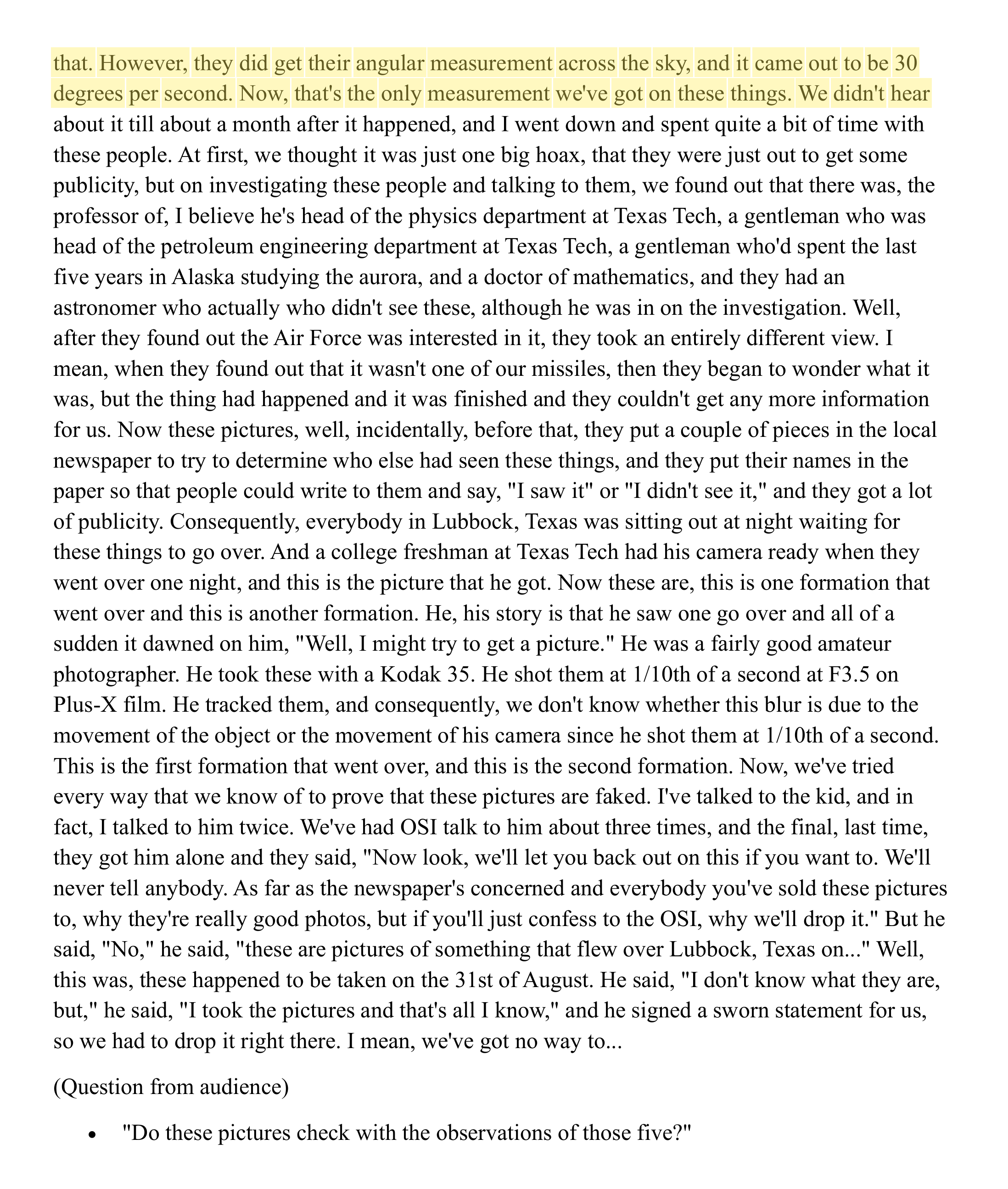
In his 26 March 1952 briefing (DOW-UAP-D154, with the original audio as DOW-UAP-PR160), Air Force project engineer Captain Edward J. Ruppelt called the Lubbock case "probably the most interesting one we've ever had." Five Texas Tech faculty - including the head of the physics department, the head of petroleum engineering, a researcher who had spent five years in Alaska studying the aurora, and a doctor of mathematics - saw lights pass over on 25 August 1951 and on several later nights.
Assuming it was an Air Force missile, they set up a baseline with two-way radios and homemade angle-measuring devices. They failed to get an altitude, but measured the angular speed: "it came out to be 30 degrees per second. Now, that's the only measurement we've got on these things." A college freshman photographed formations of lights on 31 August. Ruppelt says the OSI "got him alone" and offered to let him back out quietly; he refused and "signed a sworn statement for us."
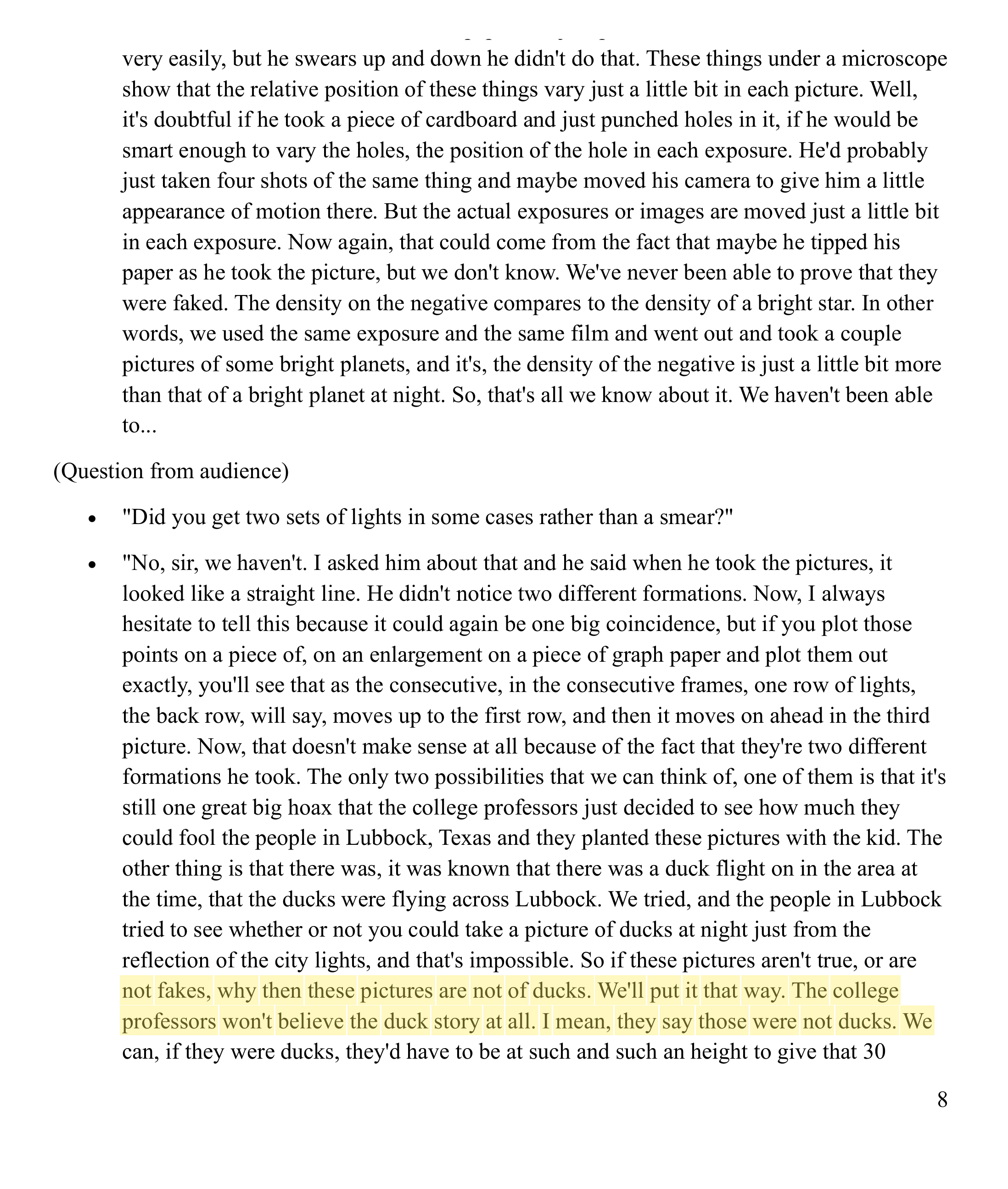
The case did not resolve cleanly, and Ruppelt said so. The professors themselves rejected the photographs - what they saw was "too dim to ever take a picture of" - and the leading mundane explanation was ducks reflecting city lights, which they also rejected: "The college professors won't believe the duck story at all." Ruppelt's conclusion: "we're up against a blank wall on this certain, this one case." The complete transcript is on our main D-154 page: https://ufodata.org/library/i-forgot-to-mention-the-contractor-inside-the-air-force-s-ufo-project-
Pages From the File
Page 7. "It came out to be 30 degrees per second. Now, that's the only measurement we've got on these things." Highlight added by UFO Data.Page 8. "The college professors won't believe the duck story at all." Highlight added by UFO Data.
August 1951. Lubbock, Texas. Five professors from Texas Tech are sitting in a backyard, talking about meteors, when a bunch of lights goes over.
The Air Force's project chief told the story in a 1952 briefing. These weren't casual witnesses. The head of physics. The head of petroleum engineering. An aurora researcher. A doctor of mathematics.
They laid out a baseline, used two way radios and homemade angle finders. They got one number: thirty degrees per second. The only measurement we've got on these things.
A college freshman photographed the lights. Investigators got him alone and offered a way out: confess, and we'll never tell anybody. He said no, and signed a sworn statement.
The twist. The five professors said his photos were fake, because what they saw was too dim to photograph. The other theory was ducks, lit by the city. The professors said absolutely not.
Ruppelt: we're up against a blank wall on this one case. Search Case D-154 at ufodata.org. Subscribe to UFO Data.