This four-page Statement of Objectives, dated 18 July 2008, defines the Advanced Aerospace Weapon System Applications Program (AAWSAP), a Defense Intelligence Agency program that ran from 2008 to 2012. Its stated objective is "to understand the physics and engineering of these applications as they apply to the foreign threat out to the far term, i.e., from now through the year 2050," and it insists that "the focus is not on extrapolations of current aerospace technology."
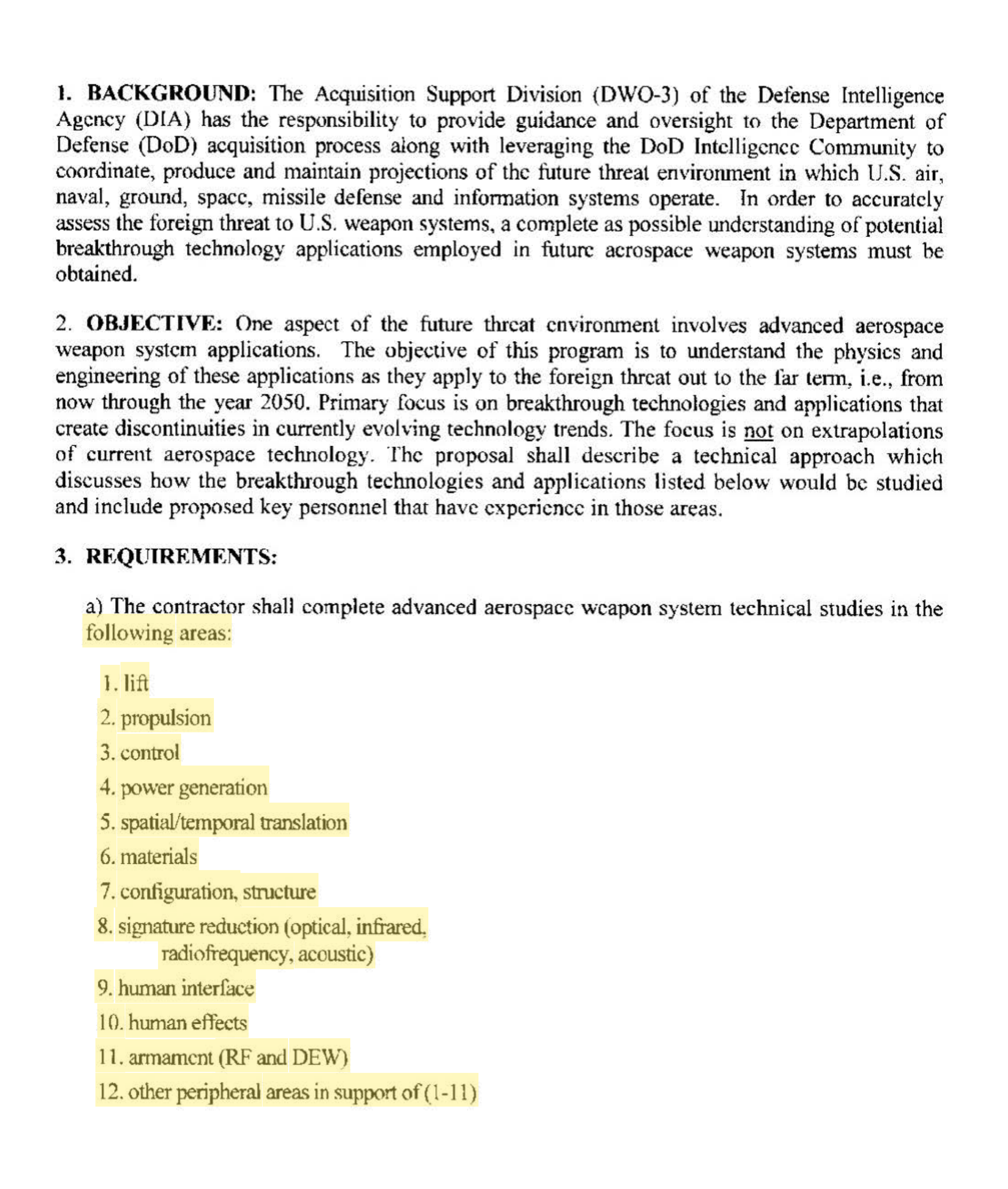
It lists twelve study areas: lift; propulsion; control; power generation; spatial/temporal translation; materials; configuration and structure; signature reduction (optical, infrared, radiofrequency, acoustic); human interface; human effects; armament (RF and directed energy); and other supporting areas. Each analytical team needed at least one PhD, and finished work had to be suitable "for dissemination at the highest levels of the federal government." The contract was framed as a base year plus four option years, firm fixed price.
What the document does not say matters as much. It contains no reference to UFOs, UAP, sightings or recovered craft - we checked the full text - and names no specific aircraft or incident. It is a research tasking about possible future foreign technology. The 37 technical papers the program commissioned (released alongside it as DOW-UAP-D117 to D-153) are literature reviews by outside researchers, not evidence of any craft. Key sections are transcribed below.
Pages From the File
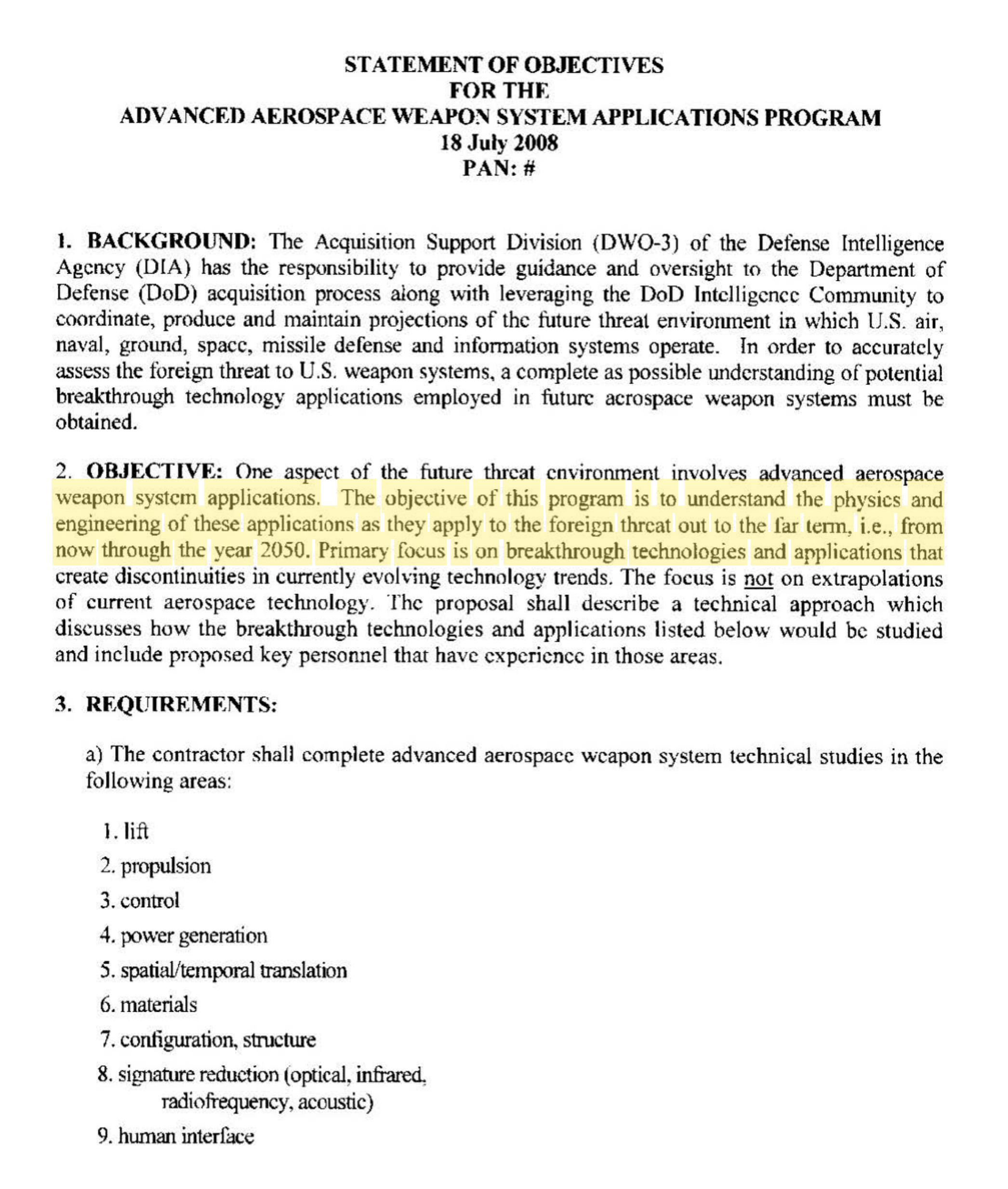
Page 1. The twelve study areas, including "spatial/temporal translation." Highlight added by UFO Data.Page 1. The objective: breakthrough technology as a foreign threat "through the year 2050." Highlight added by UFO Data.
The Document
Unmarked in the released copy18 July 2008
Statement of Objectives for the Advanced Aerospace Weapon System Applications Program (AAWSAP), 18 July 2008 - Key Sections
1. Background
The Acquisition Support Division (DWO-3) of the Defense Intelligence Agency (DIA) has the responsibility to provide guidance and oversight to the Department of Defense (DoD) acquisition process along with leveraging the DoD Intelligence Community to coordinate, produce and maintain projections of the future threat environment in which U.S. air, naval, ground, space, missile defense and information systems operate. In order to accurately assess the foreign threat to U.S. weapon systems, a complete as possible understanding of potential breakthrough technology applications employed in future aerospace weapon systems must be obtained.
2. Objective
One aspect of the future threat environment involves advanced aerospace weapon system applications. The objective of this program is to understand the physics and engineering of these applications as they apply to the foreign threat out to the far term, i.e., from now through the year 2050. Primary focus is on breakthrough technologies and applications that create discontinuities in currently evolving technology trends. The focus is not on extrapolations of current aerospace technology.
At least one member of each analytical team must have a PhD, although that member can be on several teams. ... Finished reports and presentations, while highly analytical and technical, must be in a format suitable for dissemination at the highest levels of the federal government.
Released 18 September 2026 in PURSUE Release 06 as DOW-UAP-D110 (4 pages). Key sections transcribed; the released copy's text layer is OCR with errors, corrected here against the page images. · Defense Intelligence Agency, Acquisition Support Division (DOW-UAP-D110)
July 18th, 2008. The Defense Intelligence Agency sets out the objectives for a new program, the Advanced Aerospace Weapon System Applications Program.
The goal: understand the physics and engineering of breakthrough aerospace technology as a foreign threat, from now through the year 2050.
And one line sets the tone. The focus is not on extrapolations of current aerospace technology.
Then the list of twelve. Lift. Propulsion. Control. Power generation. And number five: spatial, temporal translation.
Materials. Signature reduction, optical, infrared, radio and acoustic. Human interface. Human effects. And armament, radio frequency and directed energy.
Every analytical team needed at least one PhD, and the reports had to be fit for the highest levels of the federal government.
The statement never mentions UFOs. It's a research contract. Search Case D-110 at ufodata.org. Subscribe to UFO Data.